Interface : this wrapper is used to created easily a wrapper to a table (ORM) You must create a class extending this one, in the constructor these variables have to be defined. More...
Inherits Data_SQL.
Inherited by Acc_Other_Tax_SQL, Action_Gestion_Comment_SQL, Action_Gestion_SQL, Anc_Key_Activity_SQL, Anc_Key_Detail_SQL, Anc_Key_Ledger_SQL, Anc_Key_SQL, Attr_Def_SQL, Contact_option_ref_SQL, Currency_SQL, Currency_history_SQL, Default_Menu_SQL, Document_State_SQL, Document_type_SQL, Fiche_def_ref_SQL, Forecast_Category_SQL, Forecast_Item_SQL, Forecast_SQL, Form_Definition_SQL, Form_Detail_SQL, Jrn_Note_SQL, Jrn_Sup_Document_SQL, Jrn_Tax_SQL, Jrn_def_SQL, Jrn_periode_SQL, Menu_Ref_SQL, Noalyss_SQL, Op_Predef_SQL, Operation_Exercice_Detail_SQL, Operation_Exercice_SQL, Operation_currency_SQL, Otp_Send_Secret_SQL, Parameter_Extra_SQL, Parm_Mail_Server_SQL, Parm_periode_SQL, Payment_method_SQL, Poste_analytique_SQL, Profile_Menu_sql, Profile_Mobile_SQL, Profile_sql, Quant_Fin_SQL, Quant_Purchase_SQL, Quant_Sold_SQL, Stock_Change_Sql, Stock_Goods_Sql, Stock_Sql, Tag_SQL, Tag_group_SQL, Tmp_Pcmn_SQL, Tva_Rate_SQL, User_filter_SQL, and V_Tva_Rate_SQL.
 Collaboration diagram for Table_Data_SQL:
Public Member Functions | |
| __construct ($p_cn, $p_id=-1) | |
| __toString () | |
| build_query () | |
| Build the SQL select statement for querying the object and returns it. | |
| column_update ($column_expr, $value) | |
| update the value of a column with an expression for $value for the current record | |
| count ($p_where="", $p_array=null) | |
| return the number of count in the table corresponding to the where condition | |
| delete () | |
| exist () | |
| Count the number of record with the id ,. | |
| get_all_to_array ($p_key_col, $p_cond="", $p_array=NULL) | |
| Get all the row and use the p_key_code are the key value of array. | |
| insert () | |
| load () | |
| load a row , corresponding to the primary key | |
| seek ($cond='', $p_array=null) | |
| retrieve array of object thanks a condition | |
| update () | |
| update the row but not the column with a default value | |
| Public Member Functions inherited from Data_SQL | |
| __construct (DatabaseCore $p_cn, $p_id=-1) | |
| __get ($cols) | |
| __set ($cols, $p_value) | |
| collect_objects ($cond='', $p_array=null) | |
| return an array of objects. | |
| from_array ($p_array) | |
| Transform an array into object. | |
| get ($cols) | |
| get the value thanks the colum name and not the alias (name). | |
| get_a_virtual_col () | |
| return array of virtual cols (alias calculated, formatted cols) | |
| get_cn () | |
| get_info () | |
| get_name () | |
| get_object ($p_ret, $idx) | |
| get_pk_value () | |
| get_primary_key () | |
| get_type () | |
| getp ($cols) | |
| set the value thanks the alias name instead of the colum name if not found try the column name | |
| next ($ret, $i) | |
| get_seek return the next object, the return of the query must have all the column of the object including the virtual columns | |
| save () | |
| Insert or update : if the row already exists, update otherwise insert. | |
| set ($cols, $p_value) | |
| set the value thanks the colum name and not the alias (name) | |
| set_cn ($cn) | |
| set_name ($name) | |
| set_pk_value ($p_value) | |
| set_primary_key ($primary_key) | |
| set_type ($type) | |
| set_virtual_col ($col_name, $sql_expression) | |
| add a virtual column (formatted column, sum of 2 col, ...) | |
| setp ($cols, $p_value) | |
| set the value thanks the alias name instead of the colum name, if not found try the column name | |
| to_array ($prefix="") | |
| Turn an object (row) into an array, and the key could be prefixed with $prefix. | |
| to_row ($p_array) | |
| update the data member of current object with the value from the array. | |
| verify () | |
Additional Inherited Members | |
| Data Fields inherited from Data_SQL | |
| $cn | |
| $date_format | |
| Type of the data. | |
| $default | |
| defaullt date format | |
| $name | |
| Database connection. | |
| $primary_key | |
| Array of logical and real name. | |
| $table | |
| $type | |
| Column name of the primary key. | |
| Protected Attributes inherited from Data_SQL | |
| $a_virtual_col | |
Detailed Description
Interface : this wrapper is used to created easily a wrapper to a table (ORM) You must create a class extending this one, in the constructor these variables have to be defined.
Match a table or a view into an object, you need to add the code for each table.
- table = name of the view or empty
- select = name of the select
- name = array of column name, match between logic and actual name
- type = array , match between column and type of data
- default = array of column with a default value
- date_format = format of the date
- virtual_col After you call the parent constructor
- Note
- the view or the table must include an unique key, otherwise the load doesn't work.
- : the primary key must be an integer
it is also possible to use set_virtual_col to format data directly in the SQL{{$this->table = "schema.table";$this->primary_key = "o_id";$this->name=array("id"=>"o_id","program"=>"o_prog","date"=>"o_date","qcode"=>"o_qcode","fiche"=>"f_id",);$this->type = array("o_id"=>"numeric","o_prog"=>"numeric","o_date"=>"date","o_qcode"=>"text","f_id"=>"numeric",);$this->default = array("o_id" => "auto",);$this->date_format = "DD.MM.YYYY";global $cn;}}Interface : this wrapper is used to created easily a wrapper to a table (ORM) You must create a class...Definition table_data_sql.class.php:95- See also
- Data_SQL
Definition at line 94 of file table_data_sql.class.php.
Constructor & Destructor Documentation
◆ __construct()
| Table_Data_SQL::__construct | ( | $p_cn, | |
| $p_id = -1 ) |
Reimplemented in Anc_Key_Activity_SQL, Anc_Key_SQL, Profile_Menu, Stock_Change_Sql, Stock_Goods_Sql, Stock_Sql, and Tmp_Pcmn_SQL.
Definition at line 98 of file table_data_sql.class.php.
References $p_id.
Member Function Documentation
◆ __toString()
| Table_Data_SQL::__toString | ( | ) |
Reimplemented from Data_SQL.
Definition at line 103 of file table_data_sql.class.php.
References Data_SQL\$name, $ret, name, and type.
◆ build_query()
| Table_Data_SQL::build_query | ( | ) |
Build the SQL select statement for querying the object and returns it.
- Returns
- string Query of the object
add virtual column
Definition at line 281 of file table_data_sql.class.php.
References $a_col, Data_SQL\$primary_key, $sep, $sql, $x, count(), name, and type.
Referenced by load(), and seek().
Here is the call graph for this function:
◆ column_update()
| Table_Data_SQL::column_update | ( | $column_expr, | |
| $value ) |
update the value of a column with an expression for $value for the current record
- Parameters
-
$column_exp string like column = $1 or column=function($1) $value value replacing $1
- Note
- you can use it for entering a date with the hour and minute like this $this->column_update("field_date = to_date($1,'DD.MM.YY HH24:MI'),date('d.m.Y H:i'))
- Returns
- Table_Data_SQL
Definition at line 171 of file table_data_sql.class.php.
References Data_SQL\$primary_key, $sql, $value, and cn.
◆ count()
| Table_Data_SQL::count | ( | $p_where = "", | |
| $p_array = null ) |
return the number of count in the table corresponding to the where condition
- Parameters
-
string $p_where the condition appended to the SQL select query , where must be given array $p_array variable from the $p_where condition
- Returns
- type
Reimplemented from Data_SQL.
Definition at line 263 of file table_data_sql.class.php.
References $count, $p_array, and cn.
Referenced by build_query(), get_all_to_array(), and Stock_Goods\take_last_inventory().
◆ delete()
| Table_Data_SQL::delete | ( | ) |
Reimplemented from Data_SQL.
Definition at line 156 of file table_data_sql.class.php.
References Data_SQL\$primary_key, $sql, and cn.
◆ exist()
| Table_Data_SQL::exist | ( | ) |
Count the number of record with the id ,.
- Returns
- integer 0 doesn't exist , 1 exists
Reimplemented from Data_SQL.
Definition at line 271 of file table_data_sql.class.php.
References $count, Data_SQL\$primary_key, cn, and table.
◆ get_all_to_array()
| Table_Data_SQL::get_all_to_array | ( | $p_key_col, | |
| $p_cond = "", | |||
| $p_array = NULL ) |
Get all the row and use the p_key_code are the key value of array.
The key column is usually the primary key or any unique key. the returns looks like
- Note
- It should be used only for small tables: the array is build row by row
- Parameters
-
string $p_key_col existing and unique key string $p_cond sql cond array $p_array array of value for the SQL condition
Definition at line 328 of file table_data_sql.class.php.
References $i, $nb_array, $p_array, $ret, count(), DatabaseCore\fetch_all(), record_log(), and seek().
Here is the call graph for this function: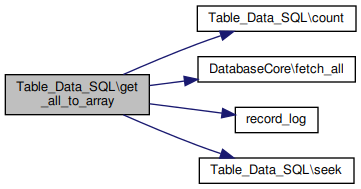
◆ insert()
| Table_Data_SQL::insert | ( | ) |
Reimplemented from Data_SQL.
Definition at line 119 of file table_data_sql.class.php.
References $array, $idx, Data_SQL\$primary_key, $sep, $sql, $value, cn, name, type, and Data_SQL\verify().
Here is the call graph for this function:
◆ load()
| Table_Data_SQL::load | ( | ) |
load a row , corresponding to the primary key
Reimplemented from Data_SQL.
Definition at line 214 of file table_data_sql.class.php.
References Data_SQL\$primary_key, $result, $sql, $value, build_query(), and cn.
Here is the call graph for this function:
◆ seek()
| Table_Data_SQL::seek | ( | $cond = '', | |
| $p_array = null ) |
retrieve array of object thanks a condition
- Parameters
-
$cond condition (where clause) (optional by default all the rows are fetched) you can use this parameter for the order or subselect $p_array array for the SQL stmt
- Returns
- the return value of exec_sql
Reimplemented from Data_SQL.
Definition at line 248 of file table_data_sql.class.php.
References $p_array, $ret, $sql, build_query(), and cn.
Referenced by get_all_to_array().
Here is the call graph for this function:
◆ update()
| Table_Data_SQL::update | ( | ) |
update the row but not the column with a default value
Reimplemented from Data_SQL.
Definition at line 181 of file table_data_sql.class.php.
References $array, $idx, Data_SQL\$primary_key, $sep, $sql, $value, cn, name, type, and Data_SQL\verify().
Here is the call graph for this function:
The documentation for this class was generated from the following file:
- include/lib/table_data_sql.class.php
Generated on Thu Jan 15 2026 10:14:41 for noalyss by
 1.13.2